|
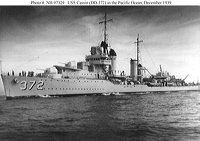
Following commissioning, the destroyer U.S.S. Cassin remained at the Philadelphia yard until March of 1937, undergoing extensive alterations due to design problems, including having her No. 3 5" gun removed to improve stability. Arriving at Pearl Harbor in April 1938, Cassin operated there and on the west coast, followed by a cruise Fiji, Samoa and Australian waters in February and April of 1941.
Cassin returned to the west coast for a short upkeep, but was soon in Pearl Harbor again. On December 7, 1941, Cassin was in Drydock No. 1 with the destroyer Downes alongside and the battleship Pennsylvania astern. An incendiary bomb hit between the destroyers, igniting Cassin’s fuel tanks and starting uncontrollable fires. An attempt to put the fires out by flooding the drydock backfired and ammunition and torpedoes exploded. Both ships were abandoned. None of Cassin’s crew were killed. Both Cassin and Downes were burned out and flooded, Cassin slipping off her keel blocks and capsizing against the Downes. In one of the superb salvage efforts that characterized the aftermath of Pearl Harbor, both destroyer’s major components, structures and weapons were salvaged and sent to Mare Island Navy Yard where essentially new destroyers with the same hull numbers were built around the salvaged parts. This was probably by far the most extensive and expensive repair of small fighting ships by the navy in World War II.
The rebuilt Cassin re-commissioned February 6, 1944 returning to the Pacific in time for operations to recapture the Marianas. Cassin provided gunfire support around Tinian in August, followed by a bombardment of Marcus on October 9th. Cassin’s next assignment was operating as part of the fast carrier task forces, providing escort and anti-submarine screening for the fleet carriers engaged in the recapture of the Philippines in October 1944. Cassin was then part of a bombardment force that engaged in pre-assault bombardments of Iwo Jima in November of 1944 and January of 1945 in support of the later invasion of that island. Patrol and escort duties as a radar picket and air-sea rescue ship occupied most of Cassin’s time for the rest of the war. Cassin was caught in a typhoon on June 6, 1945, losing a man overboard. In July Cassin fired her last shots of the war against Kita Iwo Jima. After the war, Cassin remained in the Iwo Jima area, continuing her air-sea rescue assignment and guarding the evacuation of American prisoners of war from Japanese territories.
With the war over, Cassin was classified by the navy as essentially obsolete and unneeded for further naval service, like most of the older destroyers built in the years before World War II. She sailed for Norfolk, Virginia, arriving on November 1, 1945 and decommissioning there on December 17th. Stricken from the naval register, Cassin was sold on November 25, 1947 and subsequently scrapped. (DBoyer 2007)
|