|
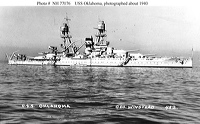
Commissioning at the Philadelphia Navy Yard just as the United States entered World War I, the U.S.S. Oklahoma was assigned to Battleship Division Six operating out of Norfolk, Virginia, until the division was sent to Bantry Bay, Ireland, to operate as part of the Royal Navy’s Grand Fleet in1918. The battleships of the division were primarily involved in protecting convoys until war’s end, seeing no combat action. The division then formed part of the escort for President Wilson’s arrival in France aboard transport George Washington en route to the Paris Peace Conference. Oklahoma was also one of the battleships that later escorted the President back to the United States.
Oklahoma was back to peacetime operations by May of 1919 and underwent a short overhaul until early 1920. Assigned to the Pacific fleet, years of training and battle problems followed with the occasional cruises to show the flag in foreign countries. Oklahoma returned to the east coast in 1927, entering the Philadelphia Navy Yard for a thorough modernization overhaul completed in 1929. Oklahoma sailed for the Pacific once again in 1930 and then back to the Atlantic in 1936 for duty in Spanish waters protecting American interests during the Spanish Civil War. By October of 1936, Oklahoma was back in the Pacific with the battle feet, basing at Pearl Harbor by 1940.
On December 7, 1941, Oklahoma was moored along Battleship Row, outboard of the Maryland. Like West Virginia astern of her, Oklahoma was in an ideal position for torpedo attack. Within minutes of the first bomb landing on Ford Island, Oklahoma had taken three torpedoes and began to list heavily to port. As the list increased, Oklahoma was hit by two more torpedoes high in the ship, rapidly increasing the flooding. Oklahoma quickly capsized, coming to a stop with her bottom and one propeller shaft exposed, her masts crushed against the harbor bottom. 415 officers and men were killed and 32 badly wounded. Thirty-two men were saved from certain death within the Oklahoma when civilian navy yard worker Julio de Castro organized a rescue team that cut through the bottom of Oklahoma’s hull, allowing the trapped men to crawl out.
Despite her capsized condition, Oklahoma was righted by December 1943 through the use of huge winches anchored on Ford Island. Her hundreds of dead were removed from her hull for burial with honors. Unlike the other salvaged battleships from Pearl Harbor, Oklahoma was not returned to service. Stripped of useable material, including her guns and superstructure, Oklahoma was decommissioned on September 1, 1944, remaining at Pearl Harbor awaiting disposal. Oklahoma was towed out of Pearl Harbor on May 10, 1947 en route to San Francisco for scrapping. On May 17, she began to break up, parted her tow lines and sank about 540 miles northeast of Pearl Harbor. For an old warrior, undoubtedly a more fitting end than scrapping. (DBoyer 2007)
|