|
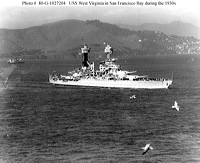
The Maryland-class battleships, Maryland, West Virginia and Colorado, were the last of the World War I designs of American battleships, very similar in hull shape and engineering plant to their predecessors of the Tennessee class. The main difference was the upgrading of the main armament to 8 - 16" guns compared to the 12 - 14" guns of the Tennessee class, done in response to the construction of the formidable 16"-gunned “Nagato”- class battleships built by the Imperial Japanese Navy.
The U.S.S. West Virginia, completed in 1922, was the last battleship constructed in America until just before World War II. Serving with the battle fleet in the Atlantic until 1939, West Virginia transferred to the Pacific Fleet at Pearl Harbor, Hawaii in 1940. On December 7, 1941, West Virginia was hit by seven torpedoes and two bombs, settling to the bottom of the harbor with a heavy list and her port side hull structure massively damaged. Excellent damage control kept West Virginia from capsizing like Oklahoma. Moored forward of the Arizona, West Virginia also received considerable topside damage when that battleship blew up. West Virginia had 106 men killed, including her Captain, Mervyn Bennion, posthumously awarded the Medal of Honor.
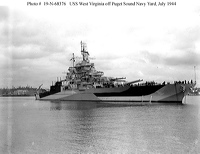
The West Virginia was patched and refloated after Pearl Harbor, proceeding to Puget Sound Naval shipyard for reconstruction. She was stripped down to the main deck and had her main turrets and engineering plant completely refurbished. Her reconstruction was massive, replacing her pre-war anti-aircraft batteries with eight modern twin 5"/38 cal. gun mounts, ten quadruple 40 mm mounts and 64 - 20 mm mounts. Large anti-torpedo bulges were fitted to the hull and the superstructure was rebuilt to the more modern wartime standards, including fitting modern navigation and fire-control radars. Slow and cumbersome by World War II standards, West Virginia was used primarily for shore bombardment duties and escorting amphibious forces upon her return to the fleet in 1944, just in time for the invasion of the Philippines and the Battle of Leyte Gulf.
On October 25, 1944, West Virginia, along with the rest of the battleships of her fire support group – Pennsylvania, Tennessee, California, Maryland (all Pearl Harbor veterans) and Mississippi, formed battle line and engaged a Japanese battle force in Surigao Strait, destroying the battleships Yamashiro and Fuso, the last battleship-on-battleship gunfight in history. Appropriately, five Pearl Harbor veterans were there. This action was followed by service at Iwo Jima and Okinawa where West Virginia was hit by a kamikaze in April of 1945, killing four men. West Virginia was present in Tokyo Bay on September 2, 1945 for the Japanese surrender. West Virginia spent fourteen years in reserve before finally being scrapped in 1959. (DBoyer 2007)
|